The Lifetime Learning Credit (LLC) remains one of the most flexible and valuable education tax benefits available to U.S. taxpayers in 2025. Whether you’re taking a single course to sharpen your skills, pursuing a graduate degree, or helping a dependent pay for school, the LLC can reduce your tax bill by up to $2,000 per return. Unlike other education credits, there’s no limit on the number of years you can claim it, making it a powerful long‑term tool for lifelong learners.
This guide breaks down everything you need to know about the Lifetime Learning Credit for the 2025 tax year, including eligibility rules, income limits, qualified expenses, and how to claim the credit correctly.
What Is the Lifetime Learning Credit?
The Lifetime Learning Credit is a nonrefundable federal tax credit designed to help offset the cost of higher education. It covers 20% of up to $10,000 in qualified education expenses, resulting in a maximum credit of $2,000 per tax return.
Unlike the American Opportunity Tax Credit (AOTC), which is limited to the first four years of undergraduate study, the LLC applies to:
- Undergraduate programs
- Graduate programs
- Professional degree programs
- Continuing education courses
- Job‑skill improvement classes
You don’t need to be enrolled half‑time or pursuing a degree to qualify making the LLC one of the most accessible education credits available.
Who Is Eligible for the Credit
To claim the LLC in 2025, you must meet all of the following IRS requirements:
1. You Paid Qualified Education Expenses
These expenses must be paid by:
- You
- Your spouse
- A dependent you claim on your tax return
- A third party (such as a parent or employer)
2. The Student Is Enrolled at an Eligible Educational Institution
This includes:
- Accredited colleges
- Universities
- Vocational schools
- Institutions eligible to participate in federal student aid programs
3. The Student Is You, Your Spouse, or a Dependent
You cannot claim the credit for someone who is not listed on your tax return.
4. You Received a Form 1098‑T
The IRS requires that you (or your dependent) receive Form 1098‑T, Tuition Statement, from the school to claim the credit.
Lifetime Learning Credit Income Limits
The IRS has not yet released updated 2025 income thresholds, but the most recent published limits (2024) phase out the credit for taxpayers with Modified Adjusted Gross Income (MAGI) between:
- $80,000–$90,000 for single filers
- $160,000–$180,000 for married filing jointly
Taxpayers above these limits cannot claim the credit.
Because the IRS typically adjusts these thresholds annually for inflation, expect slight increases for the 2025 tax year. Always check the latest IRS updates before filing.
What Expenses Qualify for the Lifetime Learning Credit?
The Lifetime Learning Credit in 2025 covers a wide range of education related expenses, including:
Qualified Expenses
- Tuition
- Mandatory enrollment fees
- Required books, supplies, and equipment only if purchased directly from the school as a condition of enrollment
Non‑Qualified Expenses
- Room and board
- Transportation
- Insurance
- Medical expenses
- Optional equipment or supplies
- Courses that do not offer academic credit (unless required for a degree program)
Lifetime Learning Credit vs. American Opportunity Tax Credit
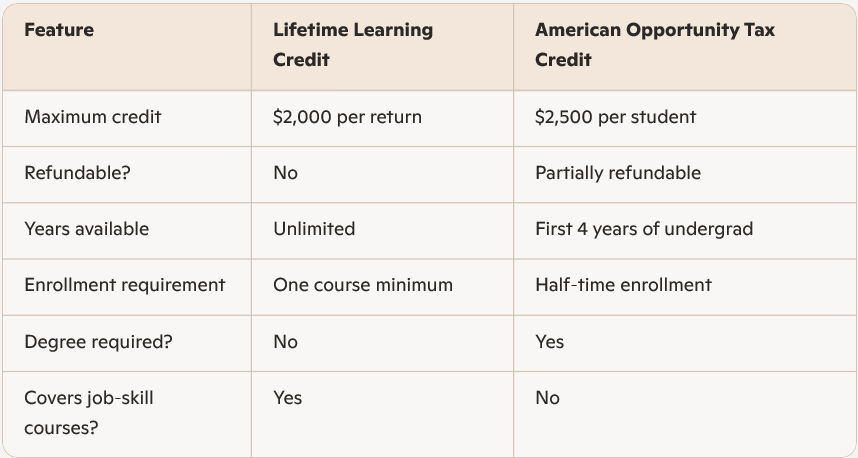
The LLC is more flexible, while the AOTC is more valuable if you qualify.
How to Claim the Credit
To claim the LLC on your 2025 tax return:
1. Gather Your Form 1098‑T
Your school must issue this form by January 31.
2. Complete IRS Form 8863
This form calculates your education credits and must be attached to your Form 1040.
3. Keep Documentation
Save:
- Tuition receipts
- Enrollment records
- Statements showing required books or fees
4. Ensure You Aren’t Double‑Claiming
You cannot claim the LLC and AOTC for the same student in the same year.
Why the Lifetime Learning Credit Matters in 2025
With rising education costs and a growing emphasis on upskilling, the LLC offers taxpayers a way to reduce their tax burden while investing in their future. It’s especially valuable for:
- Graduate students
- Working adults taking night or online classes
- Professionals earning certifications
- Parents supporting dependents in school
- Anyone improving job skills.
This article provides information only and should not be construed as advice. It is provided without warranty of any kind.