The 2025 tax year brings several important updates to tax brackets for single filers, driven largely by inflation adjustments and scheduled changes under the Tax Cuts and Jobs Act (TCJA). Whether you’re a W‑2 employee, freelancer, or investor, understanding the new brackets and deduction amounts can help you plan ahead and reduce your tax bill. This guide breaks down the 2025 federal income tax brackets, standard deduction changes, and strategies to optimize your tax situation.
2025 Federal Income Tax Brackets for Single Filers
Each year, the IRS adjusts tax brackets to prevent “bracket creep,” where inflation pushes taxpayers into higher tax brackets even if their real income hasn’t increased. For 2025, the IRS increased bracket thresholds by roughly 2.8%.
Here are the official 2025 tax brackets for single filers:
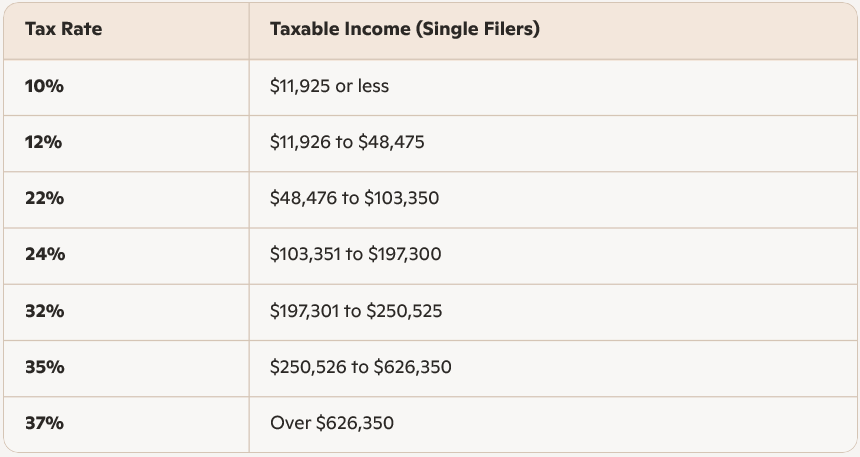
These brackets determine how much of your income is taxed at each rate—not the rate applied to your entire income. For example, if you earn $60,000, only the portion above $48,475 is taxed at 22%.
Standard Deduction for Single Filers in 2025
The IRS also adjusts the standard deduction annually. While the IRS has not yet published the final 2025 standard deduction amount, it is expected to increase modestly due to inflation, similar to bracket adjustments. In 2024, the standard deduction for single filers was $14,600, and a similar increase is anticipated for 2025.
This deduction reduces your taxable income before tax brackets are applied, making it one of the most valuable tax benefits for single filers.
How the 2025 Tax Brackets Compare to 2024 For Single Filers
The 2025 brackets are slightly wider than the 2024 brackets due to inflation adjustments. For example:
- The 10% bracket increases from $11,600 to $11,925.
- The 22% bracket now starts at $48,476 instead of $47,151.
- The top 37% bracket begins at $626,350, up from $609,351 in 2024.
These increases help offset inflation and prevent taxpayers from paying higher taxes solely due to cost‑of‑living wage increases.
Key Tax Credits and Deductions for Single Filers in 2025
1. Earned Income Tax Credit (EITC)
The EITC is available to low‑to‑moderate‑income workers. The credit amount varies based on income and number of dependents. Inflation adjustments for 2025 will slightly increase the maximum credit.
2. Child and Dependent Care Credit
If you pay for childcare or care for a dependent, you may qualify for this credit. While the enhanced pandemic‑era rules have expired, the credit remains valuable for eligible taxpayers.
3. Retirement Contribution Deductions
Contributing to a Traditional IRA or 401(k) reduces taxable income. Contribution limits typically increase annually, and 2025 is expected to follow this trend.
4. Education Credits
Single filers pursuing higher education may qualify for:
- American Opportunity Tax Credit (AOTC)
- Lifetime Learning Credit (LLC)
These credits can reduce your tax liability dollar‑for‑dollar.
Tax Planning Strategies for Single Filers in 2025
1. Maximize Retirement Contributions
Contributing to tax‑advantaged accounts lowers taxable income and helps you stay in a lower bracket. Consider:
- 401(k) or 403(b)
- Traditional IRA
- HSA (if you have a high‑deductible health plan)
2. Use Tax‑Loss Harvesting
If you have investments in taxable accounts, selling losing positions to offset gains can reduce your tax bill.
3. Bunch Itemized Deductions
If your itemized deductions are close to the standard deduction threshold, consider “bunching” expenses—such as charitable donations—into one year to maximize tax benefits.
4. Adjust Withholding Early
If your income changes in 2025, updating your W‑4 can help avoid underpayment penalties or large tax bills.
Who Benefits Most from the 2025 Adjustments?
Single filers with incomes between $50,000 and $200,000 will see the most noticeable impact from the inflation‑adjusted brackets. These taxpayers often experience bracket creep, and the wider thresholds help reduce the effect.
High‑income earners also benefit from the higher 37% threshold, which now begins at $626,350.
Will Tax Rates Change in 2026?
Yes, unless Congress acts, the Tax Cuts and Jobs Act (TCJA) provisions expire after 2025. This means:
- Tax brackets will revert to higher pre‑2018 levels.
- The standard deduction will shrink.
- Personal exemptions may return.
- Certain credits and deductions will change.
This makes 2025 a critical year for tax planning.
Final Thoughts
The 2025 tax year brings modest but meaningful changes for single filers. With higher bracket thresholds and expected increases to the standard deduction, many taxpayers will see slight reductions in their overall tax burden. By understanding the new brackets and using smart tax strategies, like maximizing retirement contributions and optimizing deductions, you can make the most of the 2025 tax landscape.