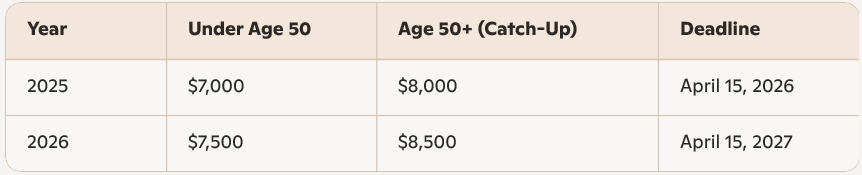
The 2026 IRA contribution deadline is Thursday, April 15, 2027. You can contribute to a traditional or Roth IRA for tax year 2026 any time from January 1, 2026, through that date, up to $7,500, or $8,600 if you are 50 or older, according to the IRS 2026 limits announcement. Filing an extension does not extend the deadline. Contributions made between January 1 and April 15, 2027 must be clearly designated as 2026 contributions. Here are the deadlines for every account type and how to use them.
2026 Retirement Contribution Deadlines
| Account | 2026 limit | Deadline for 2026 contributions |
|---|---|---|
| Traditional and Roth IRA | $7,500 ($8,600 at 50+) | April 15, 2027 |
| HSA | $4,400 self-only / $8,750 family, plus $1,000 at 55+ | April 15, 2027 |
| 401(k), 403(b), 457(b) employee deferrals | $24,500, plus catch-ups | December 31, 2026 (through payroll) |
| SEP IRA employer contributions | Up to 25% of compensation, max $72,000 | Business filing deadline, including extensions |
| Solo 401(k) employer contributions | Up to the $72,000 total limit | Business filing deadline, including extensions |
| SIMPLE IRA employee deferrals | $17,000, plus catch-ups | December 31, 2026 |
The 2026 limits are shown below for reference.
How to Make a Prior-Year Contribution
- Contribute between January 1 and April 15, 2027.
- Tell your custodian the contribution is for 2026; online platforms usually ask you to pick the tax year.
- Keep the confirmation. Your custodian will report it on Form 5498, usually by June 1, 2027.
- If you deduct a traditional IRA contribution, claim it on your 2026 return even if you file before contributing, as long as you contribute by April 15.
Why the Deadline Matters
- Lower your 2026 tax bill after the year ends. A deductible traditional IRA contribution made in early 2027 still reduces your 2026 taxable income.
- Capture a missed year. Once April 15, 2027 passes, unused 2026 room is gone for good.
- Qualify for the Saver’s Credit. Contributions made by the deadline can count toward the 2026 credit. See the Saver’s Credit.
- Complete a backdoor Roth. You can make a 2026 non-deductible contribution and convert it in 2027. See the backdoor Roth IRA.
Example
Here is how the 2026 IRA contribution deadline can still cut last year’s tax. A self-employed designer files in March 2027 and realizes she has room for a $7,500 deductible traditional IRA contribution for 2026. In the 22% bracket, contributing before April 15, 2027 cuts her 2026 federal income tax by about $1,650. She can also set up and fund a SEP IRA up to her business’s extended filing deadline for a larger deduction.
Eligibility Reminders
- You need earned income at least equal to your contribution, or a working spouse for a spousal IRA.
- There is no age limit for traditional or Roth IRA contributions.
- Roth IRA contributions phase out between $153,000 and $168,000 of modified AGI for single filers and $242,000 and $252,000 for joint filers in 2026. See Roth IRA contribution limits for 2026.
- Traditional IRA deductions phase out at lower incomes if you or your spouse have a workplace plan.
What If You Miss the Deadline?
If you miss the 2026 IRA contribution deadline, contributions made after April 15, 2027 count for 2027, not 2026. The only exception is when the IRS postpones deadlines for a federally declared disaster, which can extend the time to contribute for affected taxpayers.
What If You Contribute Too Much?
Withdraw the excess and any earnings by your filing deadline, including extensions, to avoid a 6% excise tax. You can also apply the excess to the next year’s limit, but the 6% tax applies for the year it stayed in the account.
Frequently Asked Questions
What is the 2026 IRA contribution deadline?
April 15, 2027.
Does a tax extension extend the IRA deadline?
No. The IRA and HSA deadlines stay at April 15, 2027, even if you extend your return. SEP and solo 401(k) employer contributions follow the extended deadline.
How much can I contribute to an IRA for 2026?
$7,500, or $8,600 if you are 50 or older, combined across traditional and Roth IRAs.
Can I contribute to my 401(k) for 2026 after December 31?
No. Employee deferrals must be made through payroll by December 31, 2026.
Final Thoughts
The 2026 IRA contribution deadline gives you until April 15, 2027 to lower your 2026 taxes and build retirement savings. Mark the date, designate the tax year when you contribute, and pair the move with an HSA contribution if you are eligible. Our post on when are 2026 taxes due lists other key dates.
Have questions about how this applies to your situation? Book a free consultation with Aric and get answers from a CPA.
This article provides information only and should not be construed as advice. It is provided without warranty of any kind.
