The Alternative Minimum Tax (AMT) is a parallel tax system designed to ensure that high‑income earners pay at least a minimum amount of federal income tax, even when they use deductions and credits that significantly reduce their regular tax liability. While fewer taxpayers are subject to AMT today due to inflation adjustments, it still affects individuals with higher incomes, large capital gains, or substantial deductions.
This guide breaks down how AMT works for 2025 taxes, the updated exemption amounts, who is most likely to be affected, and how to prepare your return to avoid surprises.
What Is the Alternative Minimum Tax?
The AMT operates as a separate tax framework that recalculates your taxable income by adding back certain deductions and exclusions that are allowed under the regular tax system. It was originally introduced in 1969 after reports that some wealthy individuals paid little to no federal income tax.
Under AMT rules, taxpayers must compute their tax liability twice:
- Once under the regular tax system
- Once under the AMT system
If the AMT calculation is higher, the taxpayer must pay the difference.
How AMT Is Calculated for 2025 Taxes
The AMT calculation for 2025 taxes follows a structured process:
- Start with your regular taxable income.
- Add back AMT adjustments and preference items, such as:
- State and local tax (SALT) deductions
- Certain business depreciation differences
- Incentive stock option (ISO) bargain‑element income
- Net operating loss adjustments
- Arrive at Alternative Minimum Taxable Income (AMTI).
- Subtract the AMT exemption amount.
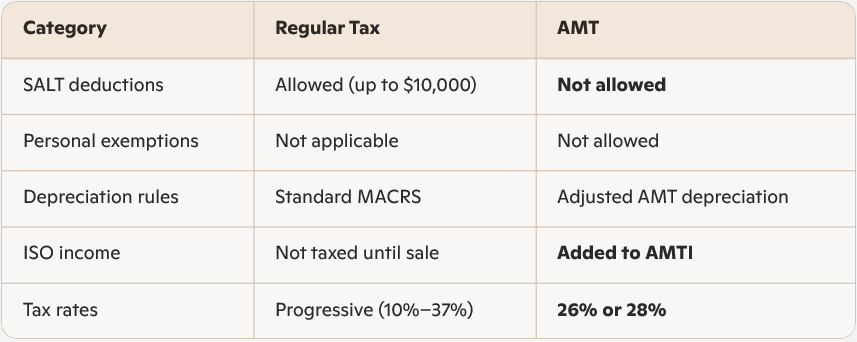
- Apply AMT tax rates (26% or 28%).
- Subtract the AMT foreign tax credit, if applicable.
The AMT is owed only if your tentative minimum tax exceeds your regular tax liability.
AMT Exemption Amounts for 2025 Taxes
For the 2025 tax year, the AMT exemption amounts have been adjusted for inflation. According to SmartAsset’s 2025 AMT update:
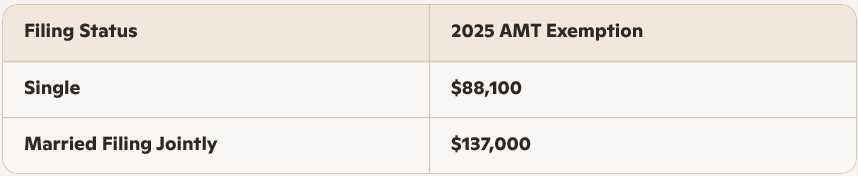
Phase‑Out Thresholds for 2025
The exemption begins to phase out at:
- $626,350 for single filers
- $1,252,700 for married couples filing jointly
Once your income exceeds these thresholds, your exemption is gradually reduced until it phases out entirely.
Who Is Most Affected?
While AMT used to impact millions of taxpayers, inflation indexing has dramatically reduced the number of people who owe it. However, certain groups remain at higher risk:
1. High‑Income Earners
Taxpayers with incomes above the phase‑out thresholds are the most likely to trigger AMT.
2. Taxpayers with Large SALT Deductions
Because AMT disallows state and local tax deductions, individuals in high‑tax states or with large property tax bills may see their AMTI increase significantly.
3. Individuals Exercising Incentive Stock Options (ISOs)
The “bargain element” (difference between market value and strike price) is added back under AMT rules.
4. Taxpayers with High Capital Gains
Large capital gains can push AMTI above exemption thresholds, even if regular taxable income remains moderate.
5. Those Claiming Significant Itemized Deductions
Certain deductions allowed under regular tax rules are not permitted under AMT.
Key Differences Between Regular Tax and AMT For 2025 Taxes
Forms Required for AMT Filing
If you are subject to AMT, you must complete:
- Form 6251 – Alternative Minimum Tax (Individuals)
This form calculates your AMTI, exemption, and tentative minimum tax.
If you paid AMT in a prior year, you may also qualify for:
- Form 8801 – Credit for Prior Year Minimum Tax
This credit allows you to recover some AMT paid in previous years when your AMT liability drops.
AMT Planning Tips for 2025 Taxes
1. Time Your Income and Deductions Strategically
If you expect to exercise ISOs or realize large capital gains, consider spreading transactions across multiple years.
2. Review SALT Exposure
High SALT deductions increase AMTI. Taxpayers in high‑tax states should evaluate whether itemizing is beneficial.
3. Monitor ISO Exercises Carefully
ISO exercises are one of the most common AMT triggers. Work with a tax professional to model the impact before exercising options.
4. Use a Tax Advisor for Complex Situations
AMT calculations can be intricate, especially for high‑income earners or those with multiple income streams.
Will AMT Affect More Taxpayers in 2025?
According to SmartAsset and NerdWallet, AMT continues to impact a smaller percentage of taxpayers due to inflation indexing, but high‑income individuals with complex financial situations remain at risk.
Final Thoughts
The Alternative Minimum Tax is designed to ensure fairness in the tax system by preventing high‑income earners from using deductions to reduce their tax liability too aggressively. For 2025, updated exemption amounts and phase‑out thresholds mean fewer taxpayers will owe AMT but those with high incomes, large deductions, or ISO activity must remain vigilant.
Understanding how AMT works, reviewing your income sources, and planning ahead can help you avoid unexpected tax bills and optimize your overall tax strategy.
This article provides information only and should not be construed as advice. It is provided without warranty of any kind.