As we enter 2026, the federal estate tax exemption has reached a historic high. For individuals and families focused on wealth preservation and legacy planning, understanding the updated estate tax rules is essential. This article breaks down the 2026 estate tax exemption, how it impacts your estate planning strategy, and what steps you should consider taking now.
What Is the Estate Tax Exemption?
The federal estate tax exemption is the amount of an individual’s estate that can be passed on to heirs without incurring federal estate taxes. If your estate’s value exceeds this exemption, the excess may be taxed at rates up to 40%.
2026 Estate Tax Exemption Amounts
Thanks to inflation adjustments and recent legislation, the estate tax exemption for 2026 is:
- $15 million per individual (up from $13.99 million in 2025)
- $30 million for married couples who elect portability
This increase stems from the One Big Beautiful Bill (OBBB), enacted in July 2025, which made the higher exemption permanent and indexed it for inflation. This means the exemption will continue to rise modestly each year unless Congress enacts new legislation.
Federal Estate Tax Rates in 2026
If your estate exceeds the exemption threshold, the excess is taxed on a graduated scale, starting at 18% and topping out at 40% for amounts over $1 million above the exemption. Here’s a quick breakdown of the 2026 estate tax brackets:
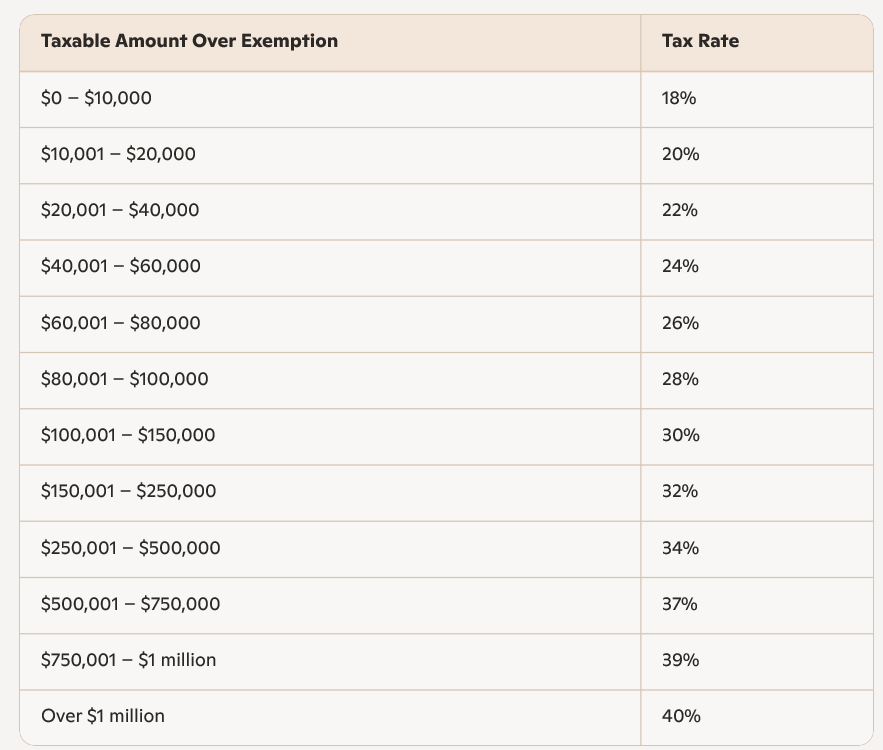
Source: IRS 2026 Estate Tax Guidelines
Lifetime Gift and Estate Tax Exemption for 2026
The lifetime gift and estate tax exemption is unified, meaning any taxable gifts you make during your lifetime reduce the amount you can pass tax-free at death. In 2026, this unified exemption is also $15 million per individual.
For example, if you’ve already gifted $5 million in taxable gifts during your lifetime, your remaining estate tax exemption at death would be $10 million.
Annual Gift Tax Exclusion for 2026
The annual gift tax exclusion remains at $19,000 per recipient in 2026. This means you can give up to $19,000 to as many individuals as you like without affecting your lifetime exemption or triggering gift tax reporting. Married couples can combine their exclusions to gift $38,000 per recipient annually.
Additionally, gifts to a non-U.S. citizen spouse are capped at $194,000 in 2026, up from $190,000 in 2025.
Why Estate Planning Matters
While the $15 million exemption shields most estates from federal estate tax, estate planning remains critical for several reasons:
- State Estate Taxes: Twelve states and the District of Columbia impose their own estate or inheritance taxes, often with much lower exemption thresholds.
- Portability Planning: Married couples must file IRS Form 706 to elect portability and preserve the unused exemption of the first spouse to die.
- Asset Protection: Trusts and other estate planning tools can help protect assets from creditors, lawsuits, and family disputes.
- Charitable Giving: Strategic philanthropy can reduce taxable estate value while supporting causes you care about.
- Business Succession: Business owners need tailored plans to ensure smooth transitions and minimize tax burdens.
Planning Opportunities in 2026
With the exemption at an all-time high, now is an ideal time to make large gifts or transfer appreciating assets out of your estate. Consider:
- Irrevocable Trusts: Use irrevocable trusts to remove assets from your taxable estate while retaining some control or income.
- Grantor Retained Annuity Trusts (GRATs): Transfer appreciating assets with minimal gift tax impact.
- Spousal Lifetime Access Trusts (SLATs): Allow one spouse to benefit from a trust while keeping assets outside the estate.
Looking Ahead: Will the Exemption Stay This High?
Although the OBBB made the $15 million exemption permanent, future administrations or Congress could reduce it. Many estate planners recommend acting now to lock in the current exemption, especially if your estate is near or above the threshold.
Final Thoughts
The 2026 estate tax exemption offers a powerful opportunity for high-net-worth individuals and families to transfer wealth tax-efficiently. However, the complexity of estate and gift tax laws—combined with potential state-level taxes—makes professional guidance essential.
Review your estate plan in 2026 to ensure it aligns with current laws exemption limits and your long-term goals. With proactive planning, you can protect your legacy and minimize tax exposure for your heirs.