Filing your federal income tax return on time is always the goal, but life doesn’t always cooperate. Whether you’re waiting on missing documents, dealing with unexpected events, or simply need more time to organize your finances, submitting a tax extension can give you the breathing room you need. If you’re preparing for the upcoming tax season, understanding how to file extension for 2025 taxes is essential. This guide breaks down the process, deadlines, requirements, and best practices to ensure you stay compliant and avoid unnecessary penalties.
What Is a Tax Extension?
A tax extension is a formal request to the IRS for additional time to file your federal income tax return. When approved, it grants you six extra months to submit your completed return. For the 2025 tax year (filed in 2026), an extension moves your filing deadline from April 15, 2026, to October 15, 2026.
It’s important to note that an extension gives you more time to file, not more time to pay. Any taxes owed are still due by the original April deadline.
Why You Might Need to File Extension for 2025 Taxes
Taxpayers request extensions for many reasons, including:
- Missing or delayed tax documents (such as K‑1s or corrected 1099s)
- Complex investment or business income
- Major life events moving, illness, family emergencies
- Needing more time to work with a tax professional
- Avoiding filing an inaccurate or incomplete return
Filing an extension is far better than rushing and making costly mistakes.
How to File Extension for 2025 Taxes
The IRS makes it relatively simple to request an extension. Here are the three most common methods.
1. File IRS Form 4868
The most widely used method is submitting Form 4868, Application for Automatic Extension of Time to File U.S. Individual Income Tax Return.
You can file Form 4868:
- Electronically through IRS Free File
- Through tax software (TurboTax, H&R Block, TaxAct, etc.)
- With a tax professional
- By mail, though electronic filing is faster and more reliable
To complete the form, you’ll need:
- Your name and address
- Social Security number(s)
- Estimated total tax liability
- Total payments made so far
- The amount you’re paying with the extension (if any)
Once submitted, your extension is automatically approved as long as the form is complete and filed on time.
2. Pay Your Estimated Tax Online
If you prefer not to file Form 4868, you can automatically receive an extension by making a tax payment using one of the IRS’s online payment systems:
- Direct Pay
- Electronic Federal Tax Payment System (EFTPS)
- Debit or credit card payment portals
Simply select “Extension” as the payment reason. The IRS treats this as an automatic extension request.
3. Use IRS Free File
IRS Free File offers a simple, no‑cost way to file an extension electronically. This option is available to all taxpayers, regardless of income, when filing Form 4868.
Key Deadlines for Filing an Extension
To successfully file extension for 2025 taxes, keep these dates in mind:
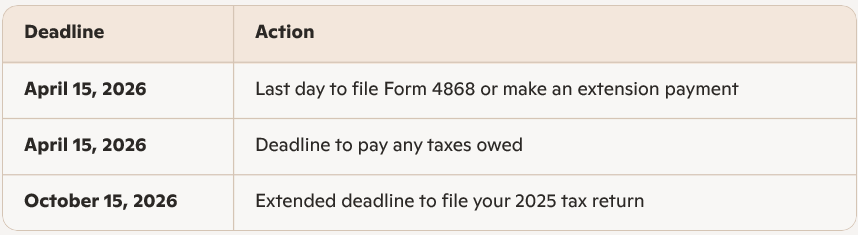
Missing the April deadline can result in penalties, even if you file your return later.
Does Filing an Extension Affect Penalties or Interest?
Filing an extension helps you avoid the failure‑to‑file penalty, which is one of the IRS’s harshest penalties. However:
- Interest still accrues on unpaid taxes after April 15
- Failure‑to-pay penalties may apply if you don’t pay enough by the deadline
To minimize costs, estimate your tax liability as accurately as possible and pay what you owe when filing the extension.
What Happens After You File Extension for 2025 Taxes?
Once your extension is accepted:
- You have until October 15, 2026, to file your return
- You can continue gathering documents and working with your tax preparer
- You can still amend your return later if needed
- You avoid the stress and penalties associated with late filing
The IRS does not send a formal approval notice for extensions filed electronically. If you file online, you’ll receive a confirmation from the software provider.
Tips for Filing a Smooth and Accurate Return After an Extension
To make the most of your extra time:
- Organize all tax documents in one place
- Review income sources carefully especially investments and self‑employment income
- Track deductible expenses and credits
- Consult a tax professional if your situation is complex
- File early, even with the extension, to avoid last‑minute pressure
Final Thoughts
Knowing how to file extension for 2025 taxes ensures you stay compliant while giving yourself the time needed to prepare an accurate return. Extensions are simple, widely accepted, and often the smartest choice when tax situations become complicated. As long as you pay your estimated tax by April 15, 2026, you can take advantage of the full six‑month extension without penalty.
This article provides information only and should not be construed as advice. It is provided without warranty of any kind.